Alphabet Beat Everything and Lost 7%. Now the Fed Is the Problem.
Market Recap — July 25th 2026 · The Philosopher Investor
2026-07-26 · 9 min read · Originally published on Substack ↗


Hello my friends,
Wednesday night Alphabet beat on every line that matters, revenue up 24%, cloud up 82%, and raised its 2026 spending plan to as much as $205 billion. The stock lost 7% the next day. Tesla missed its earnings number by a third and lost 18% on the week. And while those two burned, the S&P slipped just 0.6%, and the chipmakers, the group that was supposed to be the center of this whole scare, closed the week green.
That last part is the fact worth sitting with. The spending fear got its answer: the budgets went up. And the market answered by selling the companies writing the checks and bidding up the companies cashing them. Nvidia gained 2% and Broadcom 3% while the big spenders lost between 3% and 18%. The market has stopped arguing about whether the AI build happens. It moved on to who pays for it.
Underneath the tech drama, a bigger worry showed up. Iran declared the Strait of Hormuz closed and crude rose 10%. Jobless claims printed 187,000, the lowest since 1969. The 10-year yield climbed to 4.68%, its highest since January 2025. Polymarket now puts 71% odds on a Fed rate hike this year, against 12% on a recession. The Fed meets Wednesday. Microsoft and Meta report that same evening. This was the week the market stopped worrying about what tech spends and started worrying about what everything costs.
To get the most out of these market recaps and understand the framework behind my observations, I encourage you to read about my methodology here.
📊 Market Health
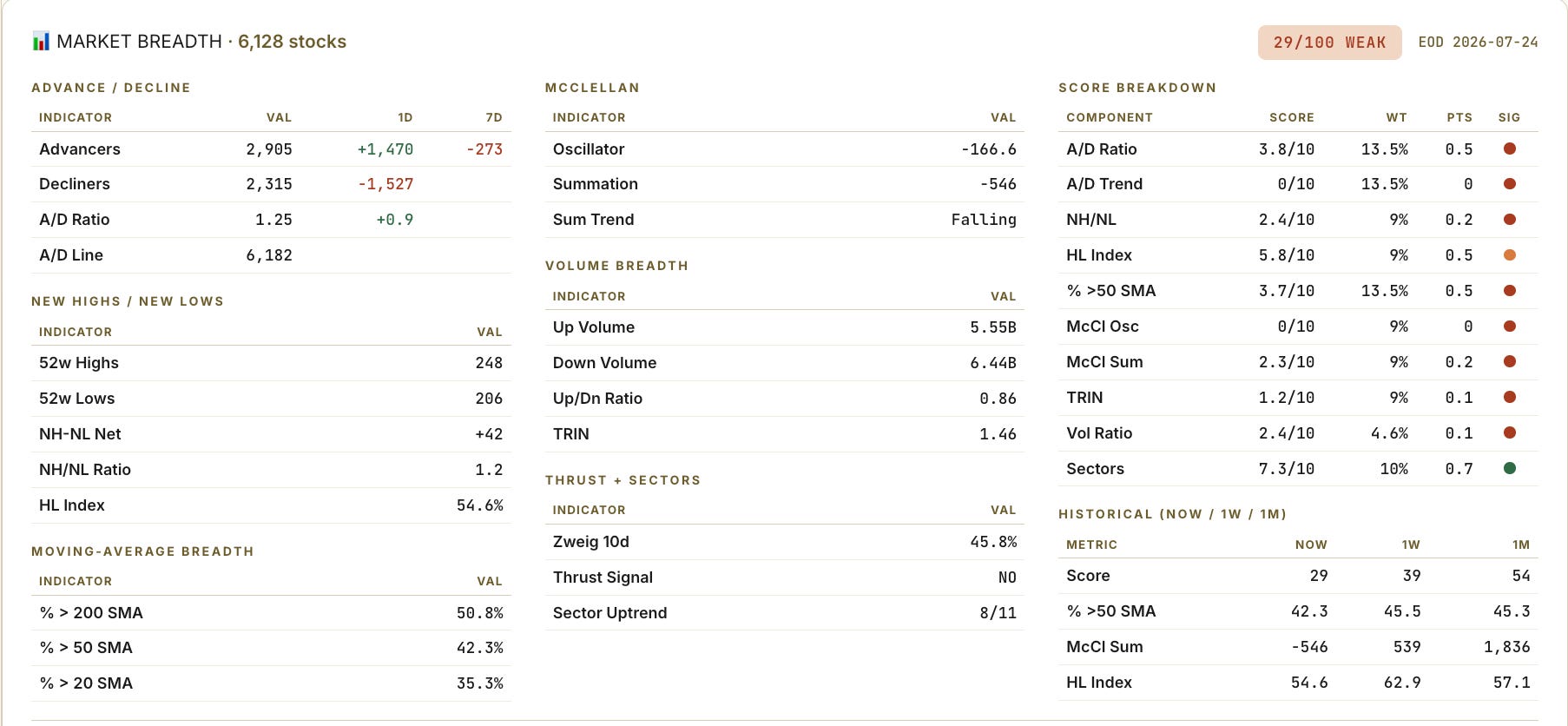
The sellers came back. That was the one thing I told you to watch, and on Thursday they returned in force. The composite health score fell to 29 from 39, a second straight defensive week, and this time it is harder to explain away. The share of stocks above their 50-day slipped to 42.3% from 45.5%, no longer a rounding error. Above the 200-day, 50.8%, a majority by less than a point. And the McClellan summation swung from +539 to -546 in five sessions, a collapse of more than a thousand points. Selling that keeps up for a week is a different animal from one heavy Friday.
Friday itself is worth a close look, because the session packed the whole week into one day. Advancers beat decliners 2,905 to 2,315, and yet down-volume outran up-volume 6.4 billion shares to 5.6 billion, with a TRIN of 1.46. The average name rose while the dollars kept leaving the mega-caps. There is the rotation in a single tape. What keeps this board off full alarm: new highs still beat new lows, 248 to 206, the smallest gap in weeks but still positive.
🚨 Sector Rotation
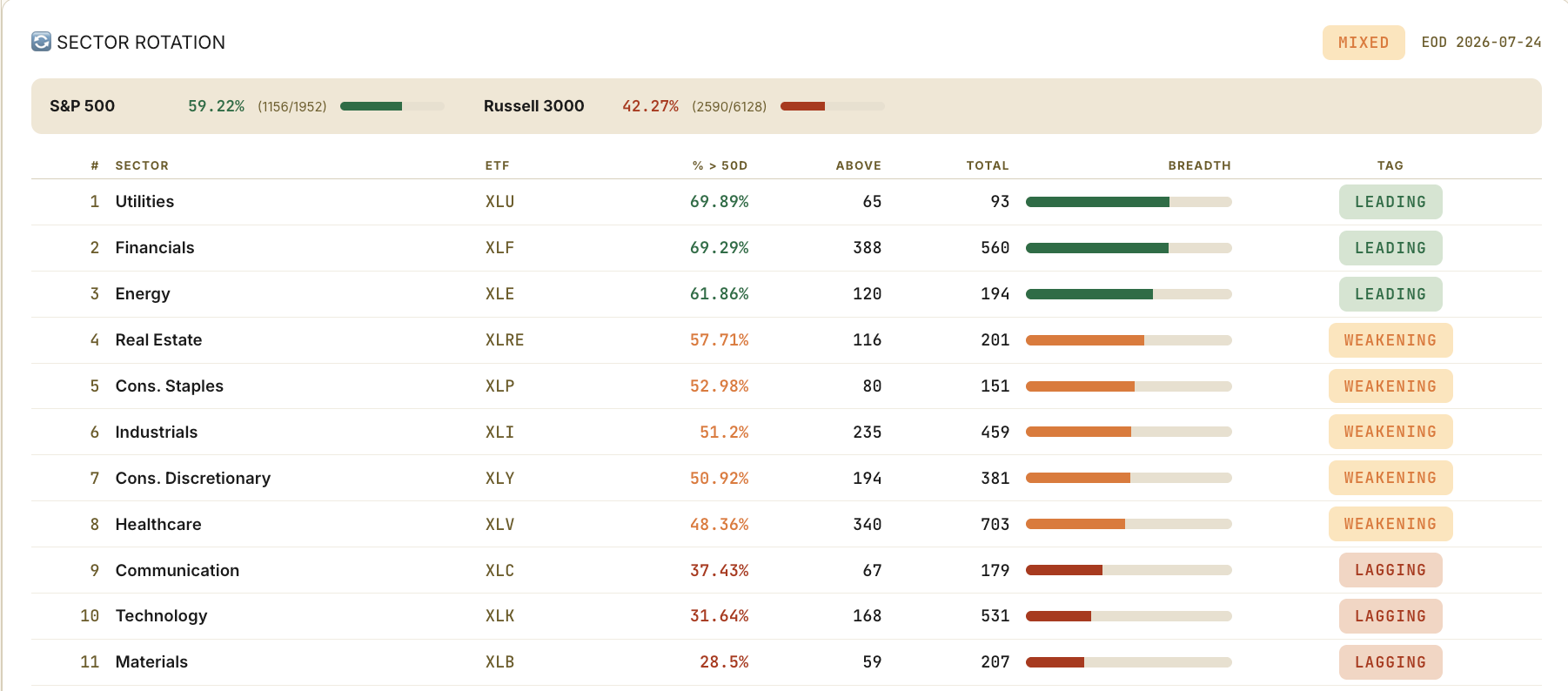
For the first time since June, the top of my leadership board is about power, and I mean the electrical kind. Utilities took first place at 69.9% internal strength. Financials eased to 69.3% from 76.4% and kept their leading tag, the earnings-backed spine still there underneath. Energy jumped to 61.9% and joined them, three weeks of oil headlines finally showing up in the stocks. Seven of eleven sectors keep a majority of their names above the 50-day, one more than last week, in a week the health score fell ten points.
The one that broke tells you what the new driver is. Real estate, last week’s fast climber at 69.5%, cracked to 57.7% the same week the 10-year hit an eighteen-month high. The rate-sensitive group rolled over first, which is what you would expect if yields are now the pressure point. Healthcare slipped below half at 48.4%, the crack I flagged last week still widening. At the bottom, technology fell to 31.6%, communication services sit at 37.4% carrying Alphabet and Meta, and materials remain last at 28.5%. Industrials quietly got stronger, helped by defense, with Lockheed up 10% on a beat-and-raise Thursday and RTX following.
So the rotation continues, but it is heading somewhere new. Three weeks ago the money left tech for balance sheets. This week it left tech for hard assets and the grid, the inflation seats. In a top the money leaves the market altogether. This money keeps changing seats, and I trade off which ones it picks. Which is why I am not cutting exposure here. I am moving it toward what is getting paid.
🔍 Pairs Alignment
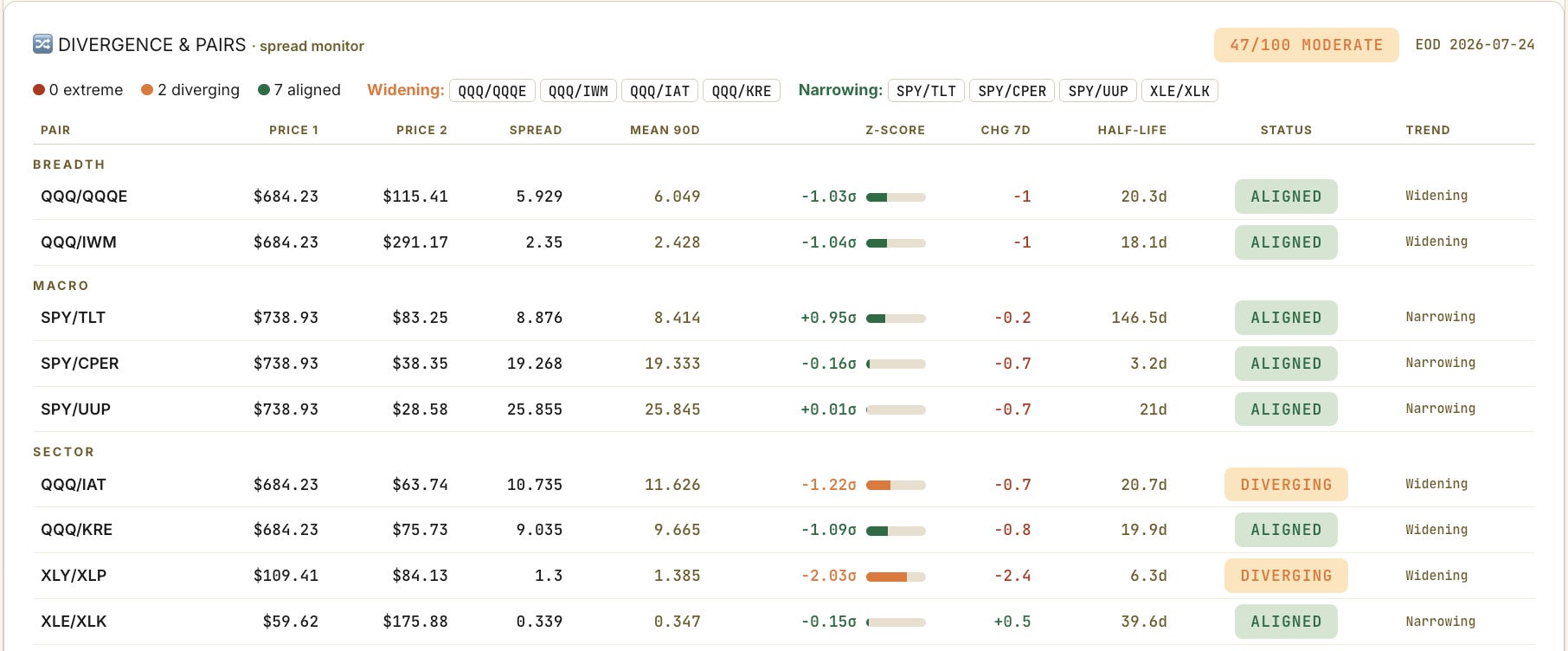
Seven of nine pairs sit aligned, none at an extreme, and the two that broke ranks both point at the same corner of the market. Large-cap tech against the regional banks, last week’s only divergence, kept widening to 1.22 standard deviations. The sell-tech-buy-banks trade kept working all week.
The new divergence is the one to study. Consumer discretionary against staples snapped to 2 standard deviations stretched in a single week, the classic sign of a consumer turning defensive. Except the discretionary leg is cap-weighted, and this week it carried Tesla’s crash. Part consumer signal, part mega-cap wreck.
The pair I told you to watch, stocks against long bonds, stayed aligned on the board, and the alignment is the bad news. It stayed aligned because both legs fell together: the 10-year rose fourteen basis points to 4.68% and long-bond funds lost 1.5% in a down week for equities. Last week duration finally acted like a shelter and I told you the haven had shown up. It lasted five sessions. Bonds sell off when the fear is inflation, and inflation is what oil at $90 and jobless claims at a 57-year low smell like.
📉 Volatility
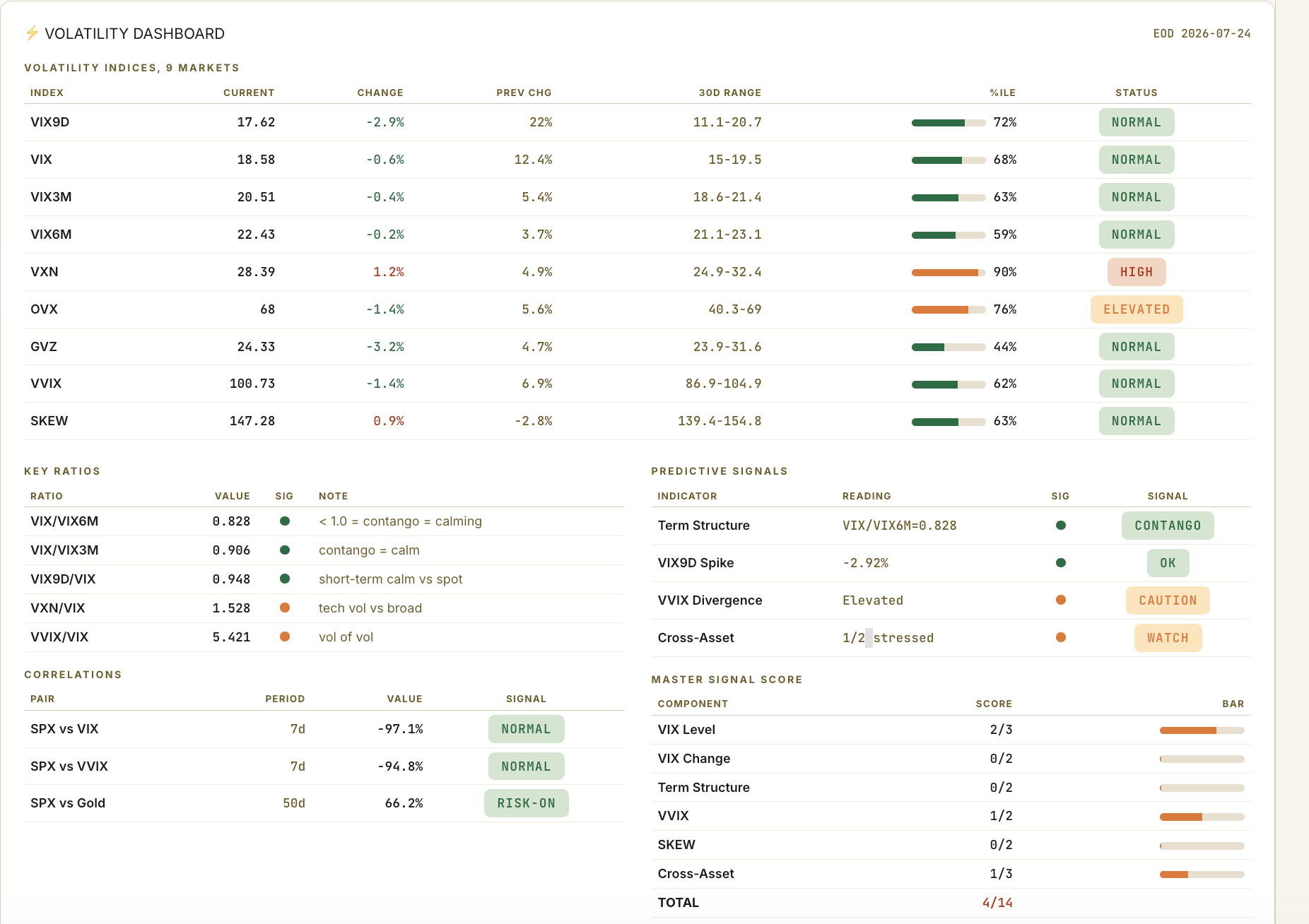
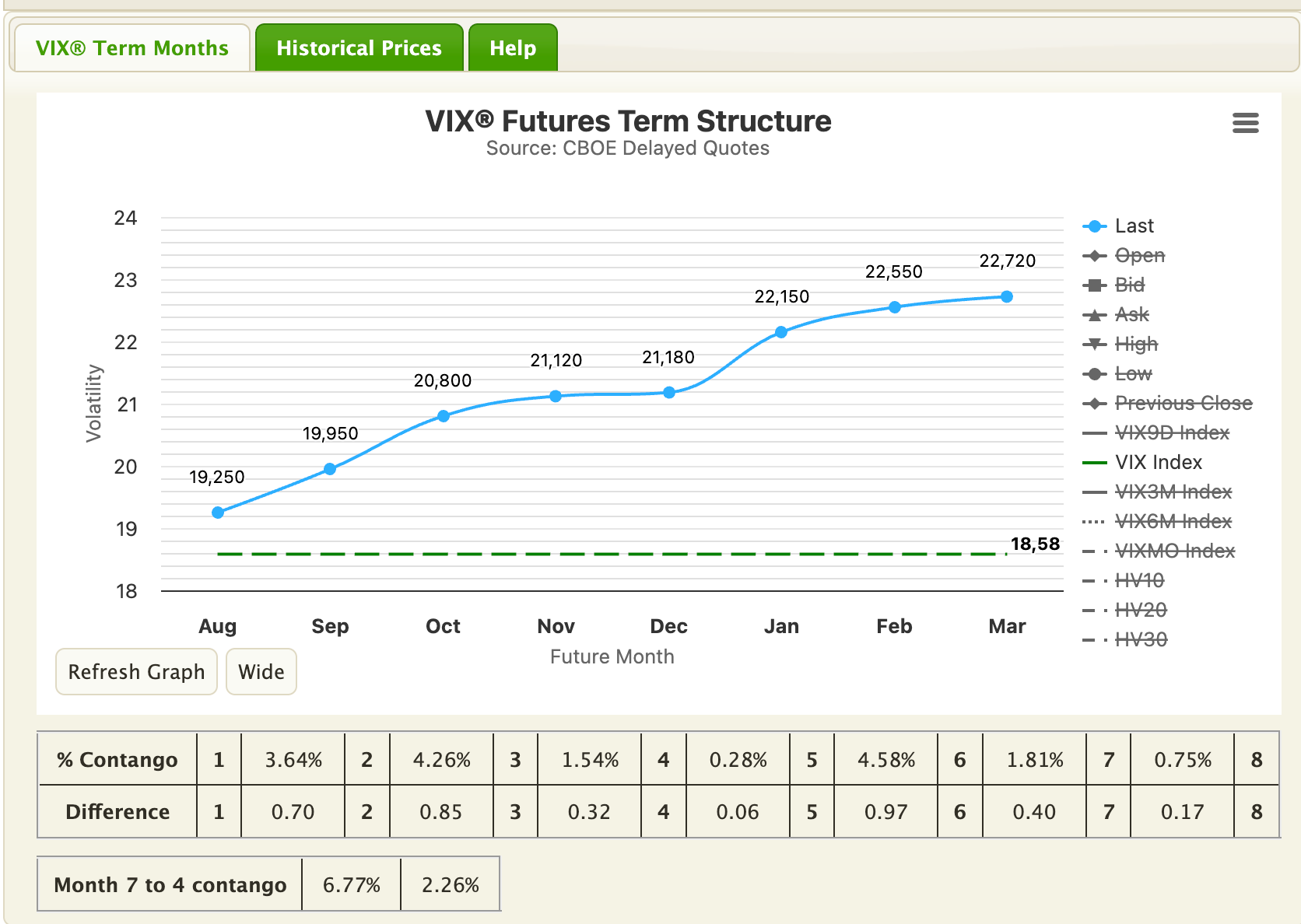
For a month Nasdaq volatility sat at the top of my board and I kept telling you it was the only hedge worth owning. Wednesday night the thing it was pricing arrived: a 7% gap down in Alphabet, a 15% single-day drop in Tesla. And Nasdaq vol finished the week lower at 28.4, still the 90th percentile of its year but coming down. That is what insurance looks like after the claim gets filed. The broad VIX ended at 18.6, down on the week, the three-month gauge above 20, the curve firmly in contango. A week like that, and the index still refuses to treat this as a market-wide problem.
Meanwhile the bid moved to the oil patch. Crude volatility rose 13% on the week to 68, the 76th percentile of its year and climbing. Hormuz is being paid for there, in real premium, and nowhere else on the board. So the tech hedge did its job and got cheaper, and the premium worth owning now trades on the price of a barrel. If I were paying for protection this week, I would pay for it there.
💱 FX
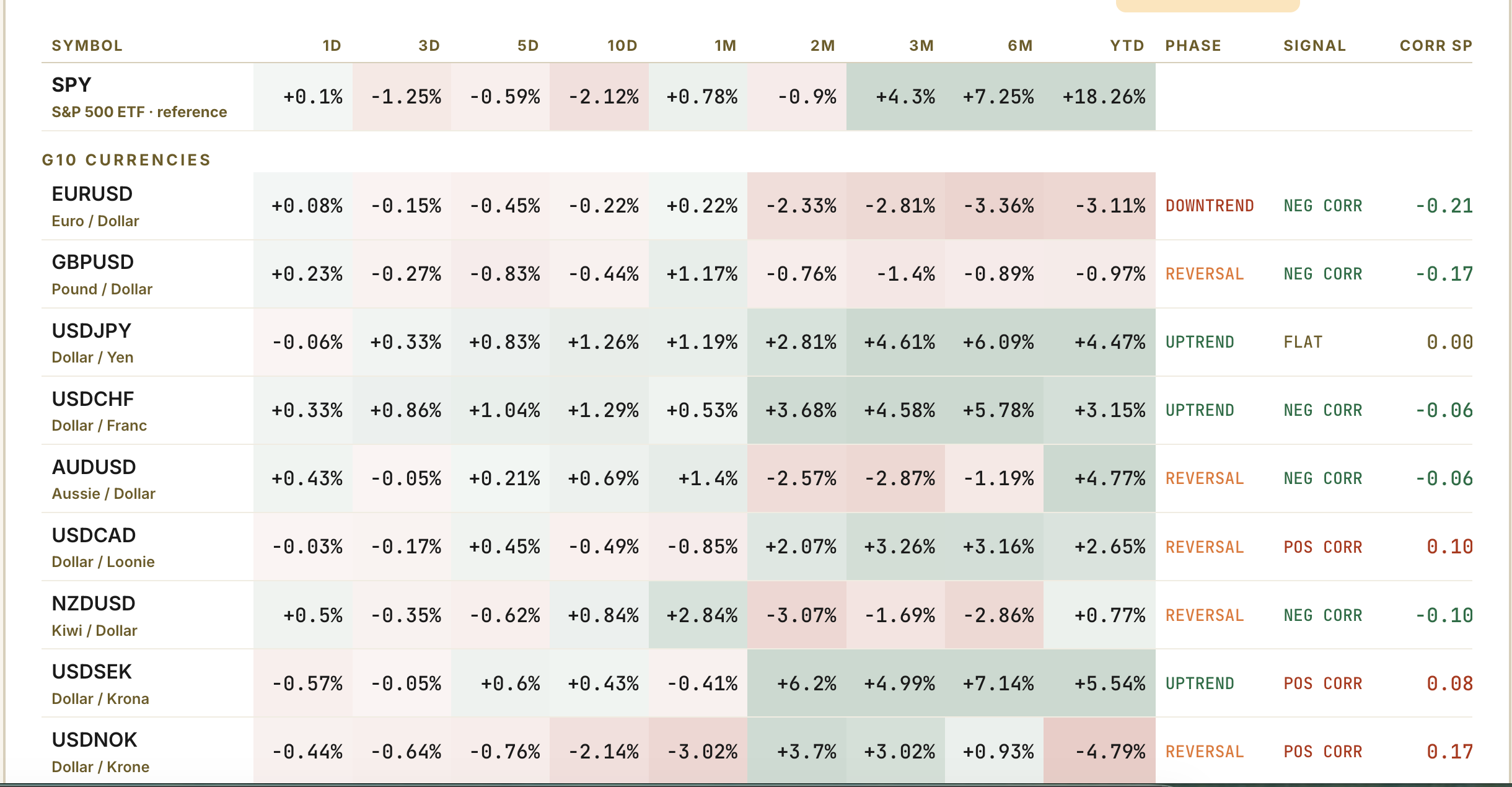
The dollar finished higher against nearly every major on the board, and it did it quietly, which is itself information. The franc, the currency that rallies when the shooting gets real, fell 1% against it, and the yen kept sliding. Zero panic anywhere in the funding currencies, for the fourth week running.
Gold is the exception, and it is the right kind. The metal rose through $4,000 while stocks fell, the first week in a month it behaved like a hedge again. My risk-off recipe, the franc rising while stocks fall and vol spikes together, printed zero of its three ingredients again. So I am not paying for disaster insurance this week.
🧠 My Take
The AI spending scare I watched all month got its answer: the chips closed green while the spenders bled. The market has decided the build is real and moved on to the bill. The new subject is the price of everything. Crude up 10% with the strait closed, the 10-year at 4.68%, a prediction market putting 71% on a hike this year. All of it lands on the Fed’s table Wednesday at 2pm, with Microsoft and Meta reporting that same evening. Rates and capex, both on the record in one afternoon.
Chop and rotate, 40%. The Fed admits the inflation problem without promising a hike, Microsoft and Meta guide the way Alphabet did, and the platforms find their footing. Money keeps paying utilities, energy and financials, and breadth steadies above its 200-day majority.
The inflation squeeze, 35%. Crude holds above $90, the Fed leaves the hike door open, the 10-year presses toward 5%, and the selling goes broad through the multiple, which reaches every sector at once. Real estate already showed you what that looks like. Here, cutting exposure matters more than picking sectors. A weekly WTI close above $95 moves this to base case.
Relief, 25%. The strait reopens, crude gives back the spike, hike odds fall, and the sold platforms snap back with Alphabet leading, since its report was a beat everywhere except in the market’s mood.
🔥 Trade of the Week:
A company that beat on every line got thrown out with the trash.
That is the trade.
Wednesday night Alphabet printed a blowout, revenue up 24% and cloud up 82%, then raised its capital budget, and the market sold it down 7% the next day on that line alone. The market is pricing a decline; the numbers show growth. And the same tape that punished Alphabet for writing the checks spent the week bidding up every company cashing them, so the market clearly believes the spending works. It just does not want to own the bill.
The setup
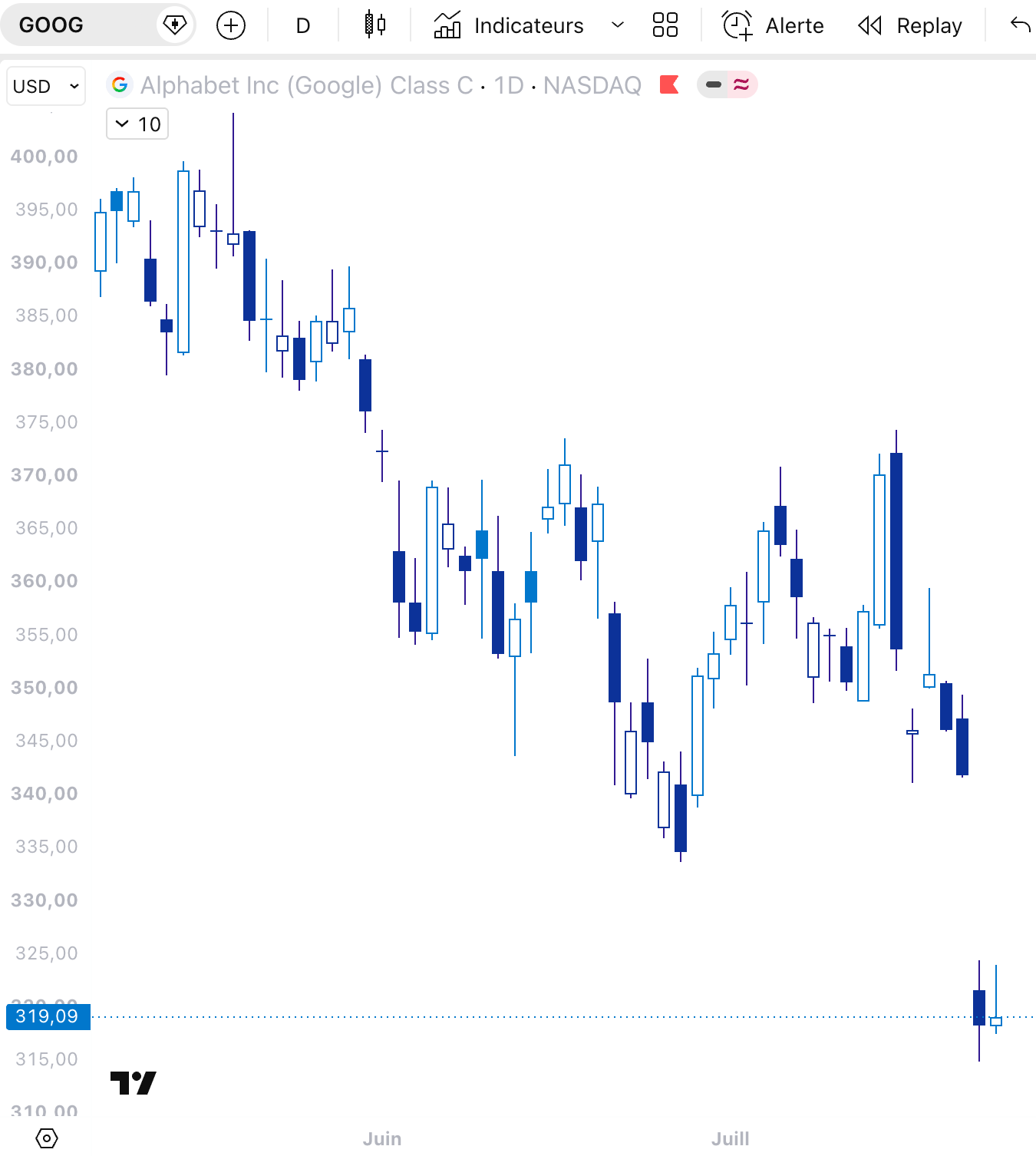
Google was already sliding before earnings, from the mid $370s to $342 the day before the report. The gap took it clean through, and it closed the week at $319.74. Here is what makes it a trade: all of March this name lived between $272 and $312, and one brutal night gave back everything it had gained since spring yet never touched that base. Thursday’s low was $314.90, above the top of the entire March range. The floor Thursday’s selling could not even reach is the floor I am leaning on.
The honest part
I am buying a gap-down in the sector sitting near the bottom of my board, in a tape that is getting worse, four days before Microsoft and Meta report into the same fear. If those two guide their own spending up Wednesday night and the market reacts the way it did here, this entry gets tested immediately.
The real risk is the story. If “they spend and get nothing back” becomes the accepted view, good numbers stop mattering, because a re-rating does not care about this quarter. Friday’s Chinese-model headline showed how fast a second story piles on. The stop is the only honest answer to all of it, so it does not move.
There is a calmer version of this trade: wait for Wednesday to clear. It costs you the first move and buys you the answer. Defensible too.
The levels
Entry: around $319, half now, half toward $305 to $310 if the mega-cap prints hand it to me.
Stop: a close below $296.60, back inside the March base. Price trades there and the idea is dead. Below it I am gone, and I do not average down.
Target 1: $342, filling the earnings gap, about one times the risk from the first entry, and I trim a third. A small first target is the price of holding through an event week.
Target 2: $366, the pre-slide shelf, about two times the risk, another third off.
Stretch: a runner toward $402, the old closing high, close to four times the risk and a 26% move, if the market rethinks what that spending buys.
Sizing: small. A beaten mega-cap in a defensive tape, with the Fed and two more capex guides landing Wednesday, deserves a starter and nothing more. If it runs to the first target inside a week, take the win and go.
See you next week,
Daniel
P.S. The app is the daily version of what you just read, the same boards and screeners I run every morning before I trade. It now comes with a free 7-day trial.
Disclaimer
This newsletter is for educational and informational purposes only. It is not financial advice.
The content reflects personal opinions shared publicly as a journal. Trading stocks, options, futures, or any financial instrument involves significant risk. You can lose your entire investment. There is no guarantee of profit.
The author is not a registered investment advisor, broker, or financial professional with any regulatory authority including the SEC or CFTC. Always consult a licensed financial advisor before making any investment decisions.
By reading this newsletter, you accept full responsibility for your own trading and investment choices. Past performance does not guarantee future results. Markets are unpredictable.
Screenshots are courtesy of TradingView, VixCentral, and other platforms with which the author has no affiliation. Information shared may contain errors or become outdated quickly.
This content is the intellectual property of the author. Copying or redistributing without permission is prohibited.
By continuing to read, you acknowledge and accept these terms.
Read the desk every week
Market analysis in plain English, plus the app that scans the whole US market for you.
Become a member Read the original on Substack ↗