Gold Had Its Best Week Since January.
Market Recap — August 9th 2026 · The Philosopher Investor
2026-08-09 · 10 min read · Originally published on Substack ↗


Hello my friends,
The market spent this week paying for two different things, and only one of them exists.
The first is a promise. On Monday and Tuesday equities went vertical on strong earnings and on word that the Strait of Hormuz was about to reopen. The Dow closed above 54,000 for the first time in its history, Palantir added 29% in a day, and those two sessions delivered almost all of the week. The reopening is the part that does not exist yet: eight days after the announcement, the strait has not passed a single extra tanker.
The second is a proof. Two employment reports landed this week, a private one on Wednesday and the official one on Friday, and both said the same thing: the job market is weakening. July lost 23,000 jobs against an expected gain of 83,000. That killed the September rate hike, and the asset that responds purest to the price of money answered. Gold rose seven percent to $4,341, its best week since January, while the VIX closed at 14.90, so this was no flight to safety. Gold moved because the rate path moved, on data that has already printed.
The market paid full price for both stories.
Before the boards, the jobs report deserves one closer look, because half of the bad number is calendar. Teachers rolled off summer payrolls, and hospitality shed the staff it had hired for a World Cup that ended. Strip those two lines and the print flips positive. I hold that as a hypothesis until the August report confirms it or kills it.
What survives is still ugly: May and June were revised down by 103,000, and the household survey, the quieter half of the report, shows a quarter of a million people leaving the labor force, with participation at a five-year low. The unemployment rate improved only because people stopped looking.
Lindsay Rosner, who runs multi-sector fixed income at Goldman, counted the pattern: for the third year in a row, “July jobs data saw a mid-summer loss of momentum.”
To get the most out of these market recaps and understand the framework behind my observations, I encourage you to read about my methodology here.
📊 Market Health
The composite went from 34 to 84 in five sessions, and I distrust any number that moves that fast, so I went to the components. They agree. The McClellan summation, which carried a deficit of 546 two weeks ago, closed at +347 and rising, and a single burst of buying cannot move that measure: it only turns when buyers keep showing up day after day. The selling pressure that owned July is gone, and it was gone before Friday's report printed.
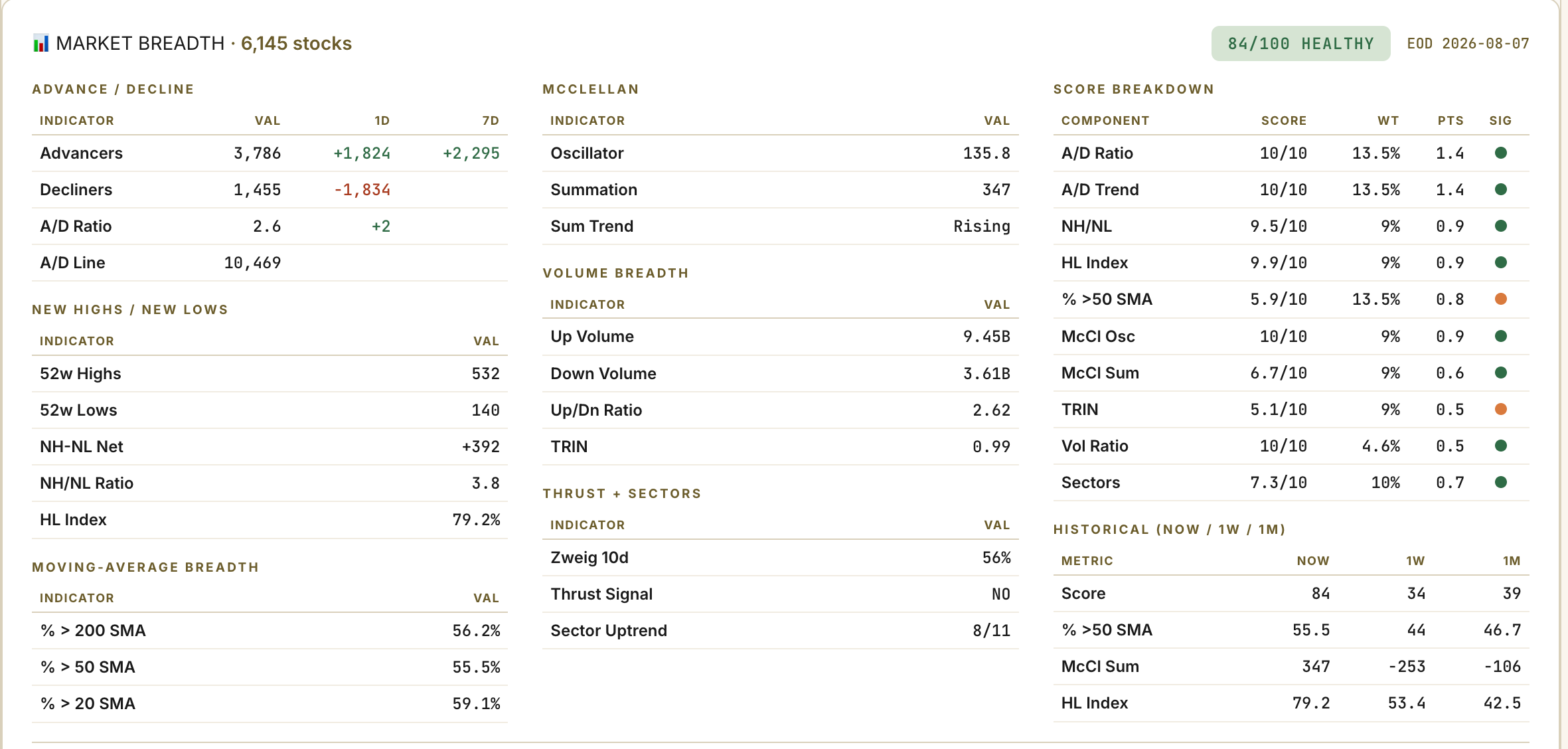
The thing I flagged last Sunday as the thinnest signal of the summer resolved upward: new highs buried new lows, against a Friday one week ago when the index rose while nearly three thousand stocks fell. The share of stocks above their 200-day average broke its freeze too, from 51.5% to 56.2%, a real majority for the first time since June.
Here is the day-by-day, because it splits cleanly between the engines. The composite ran from 34 to 67 on Monday and Tuesday with the promise, gave back eleven points midweek, then jumped to 84 on Friday’s report, and Friday was also the best participation session of the five, with 3,786 advancers against 1,455.
The order of those days matters. The best breadth session of the week came from Friday’s jobs report, so what Friday added, Wednesday’s CPI can remove. I trust the summation: it has been climbing for eight straight sessions. The share above the 200-day I trust less: it spent two weeks frozen near 51.5%, broke out on Monday, and a couple of red sessions would put it right back.
🚨 Sector Rotation
Technology gained 7% on the week, and a cheaper rate path lifts the longest duration cash flows first, which is why the gain belongs almost entirely to Nvidia, Broadcom and Microsoft. The sector still ranks near the bottom in participation at 54.3%, and the median technology stock went nowhere for a second straight week. Last Sunday this was a Microsoft story; it is three names now. If the rate engine were driving equities the way it drove gold, the whole duration complex would be moving. Three stocks are moving.
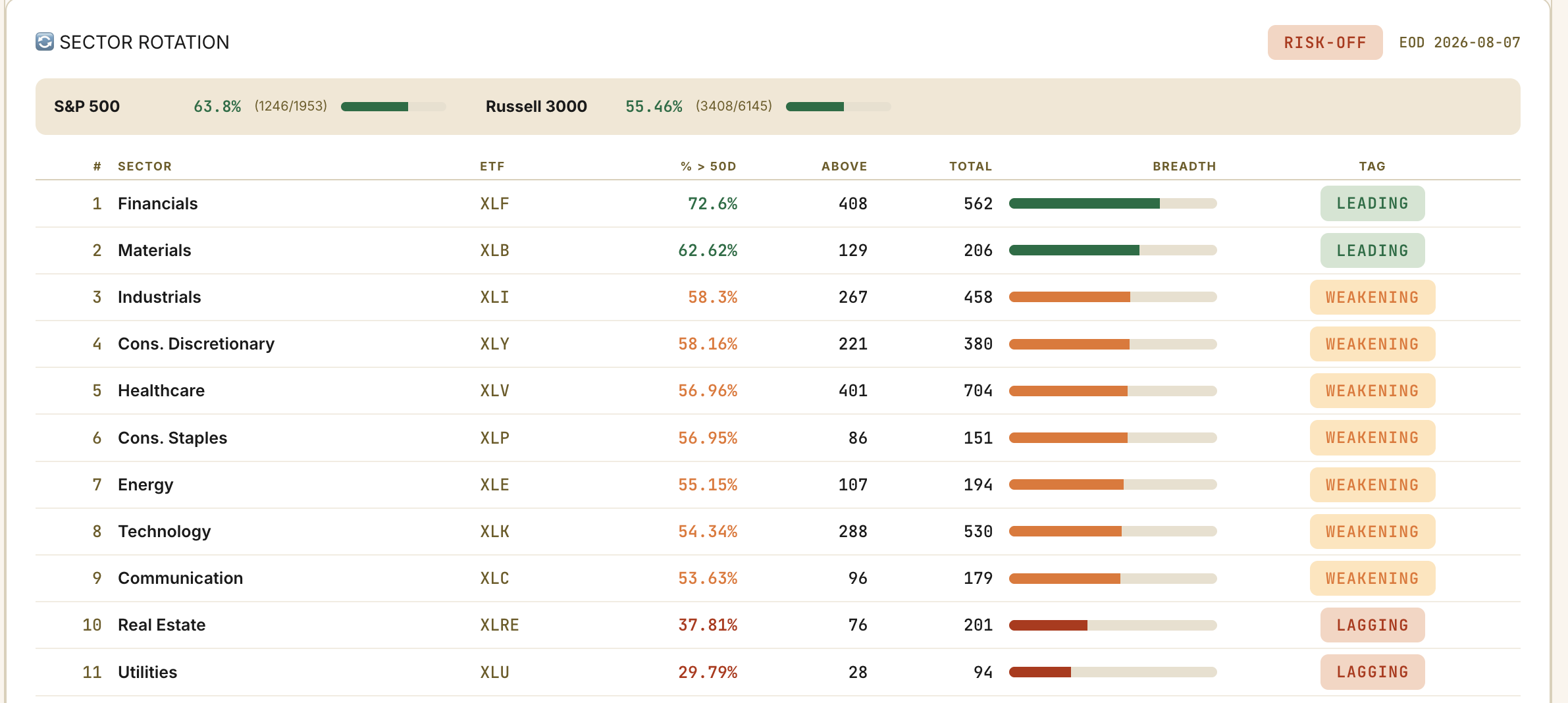
Financials next. A market that just erased a rate hike should be selling banks, and on price it did: up 1.2% in a week the index made 3.5%. Underneath, nobody left. 72.6% of the sector sits above its 50-day, the deepest participation on my board, two weeks running.
Utilities are the strangest line on the board. The bond arithmetic that explained their collapse two weeks ago stopped working this week: yields fell, the excuse to bounce arrived, and the group finished dead last at 29.8% anyway. A sector that ignores good news knows something the rest of us do not yet. I am watching for it.
Energy is where the money left, down 3.4% with the strait still shut, while its internals held up at 55.2%. That is a war premium coming out, and the volatility board says the same thing with more conviction.
🔍 Pairs Alignment
Last week I named my two live risks as rates and concentration. Rates resolved in my favor and concentration got worse: the cap-weighted indexes beat their equal-weight versions again, and the gap has widened three weeks running.
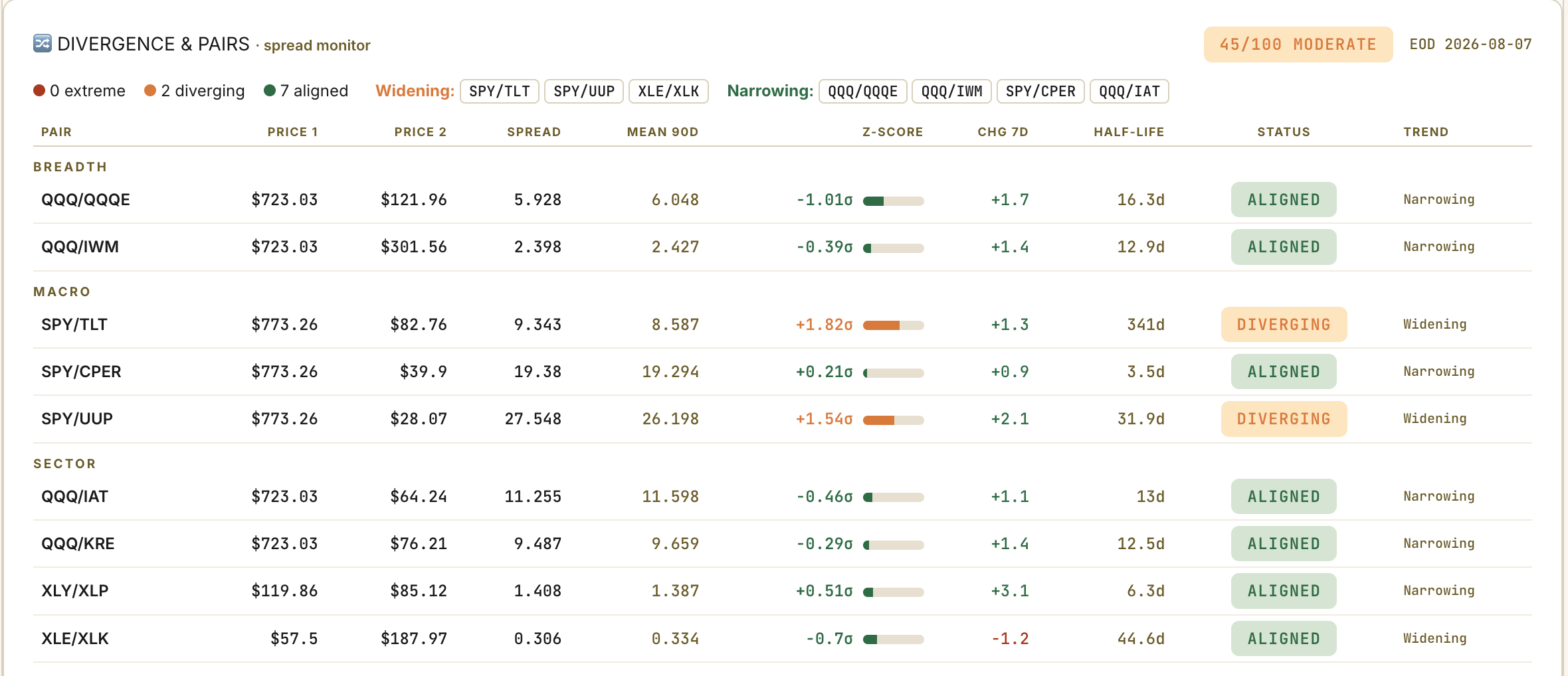
Stocks against long bonds went the relief way for the first time in a month, and it went from the bond side: Treasuries stopped falling while equities ran. That is the cleanest evidence I have that those two employment reports changed something structural in how this market prices duration, because bonds are slow and they do not move on sentiment.
The pair I am watching into next week is gold against real rates. Bullion took the repricing further than the bond market has agreed to. One of them is early and one of them is wrong.
📉 Volatility
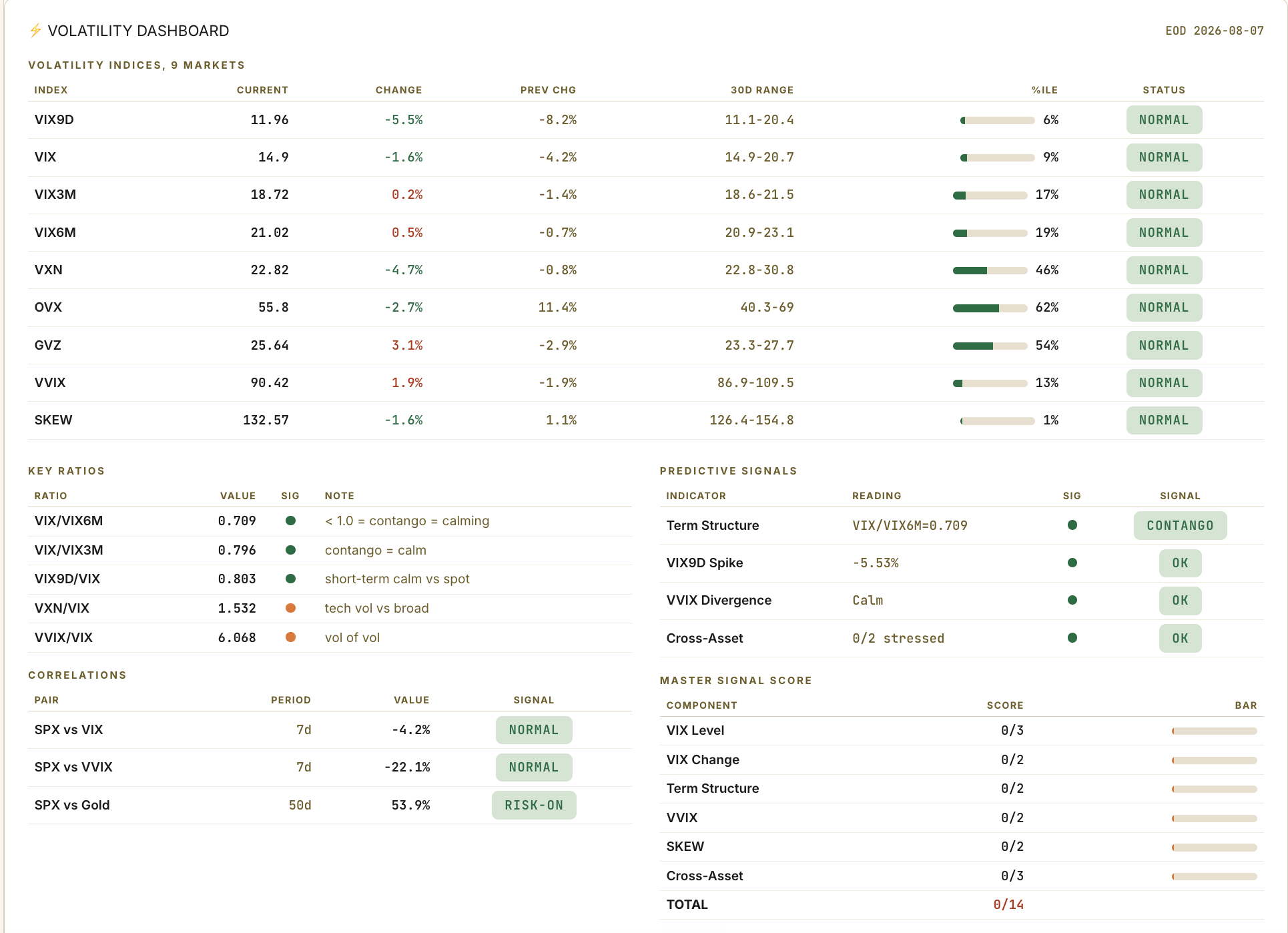
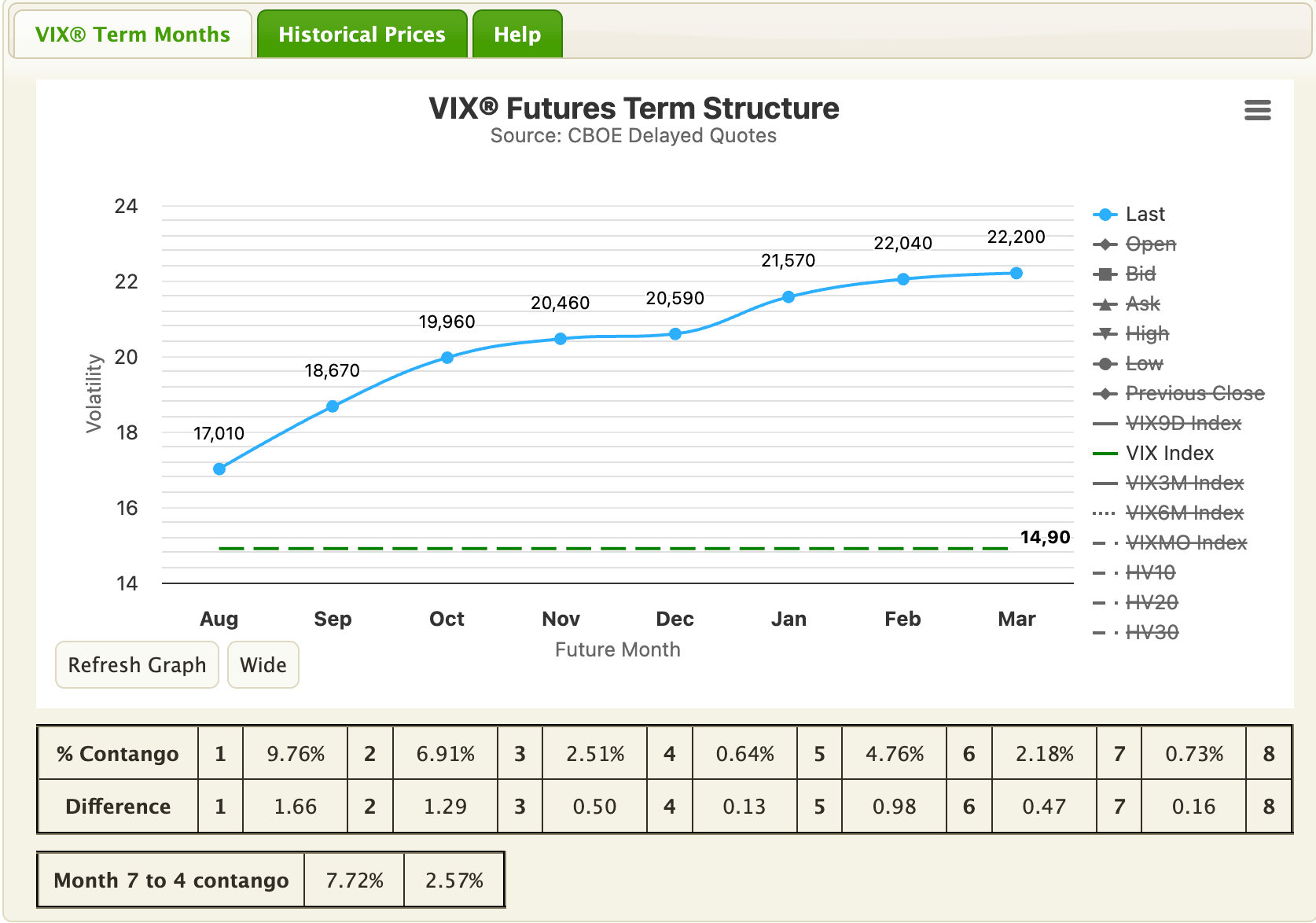
Start with the equity surface, which priced the rate path as a question already settled. The VIX closed at 14.90, the curve sits in contango at every tenor, and nothing on this surface carries any stress at all.
Crude volatility is where I owe you a correction. Last Sunday I framed it as a coin flip: a reopening kills the premium, a dead deal brings it back. Neither happened. Tehran still calls the talks the final stages, a parliamentary committee is reviewing a bill to ban hostile vessels outright. Crude vol fell 11.5% anyway. Sellers of that insurance have stopped pricing a reopening date.
They are pricing a stalemate, and a closed strait nobody will fight over stops paying a war premium even while it stays closed.
One number before Wednesday. The SKEW index, which prices the deep out-of-the-money puts that pay in a crash, sits in the first percentile of its own twelve months, and the VIX in the ninth. Crash insurance has not cost less in a year, two days ahead of the only event I have named as a real risk.
💱 FX
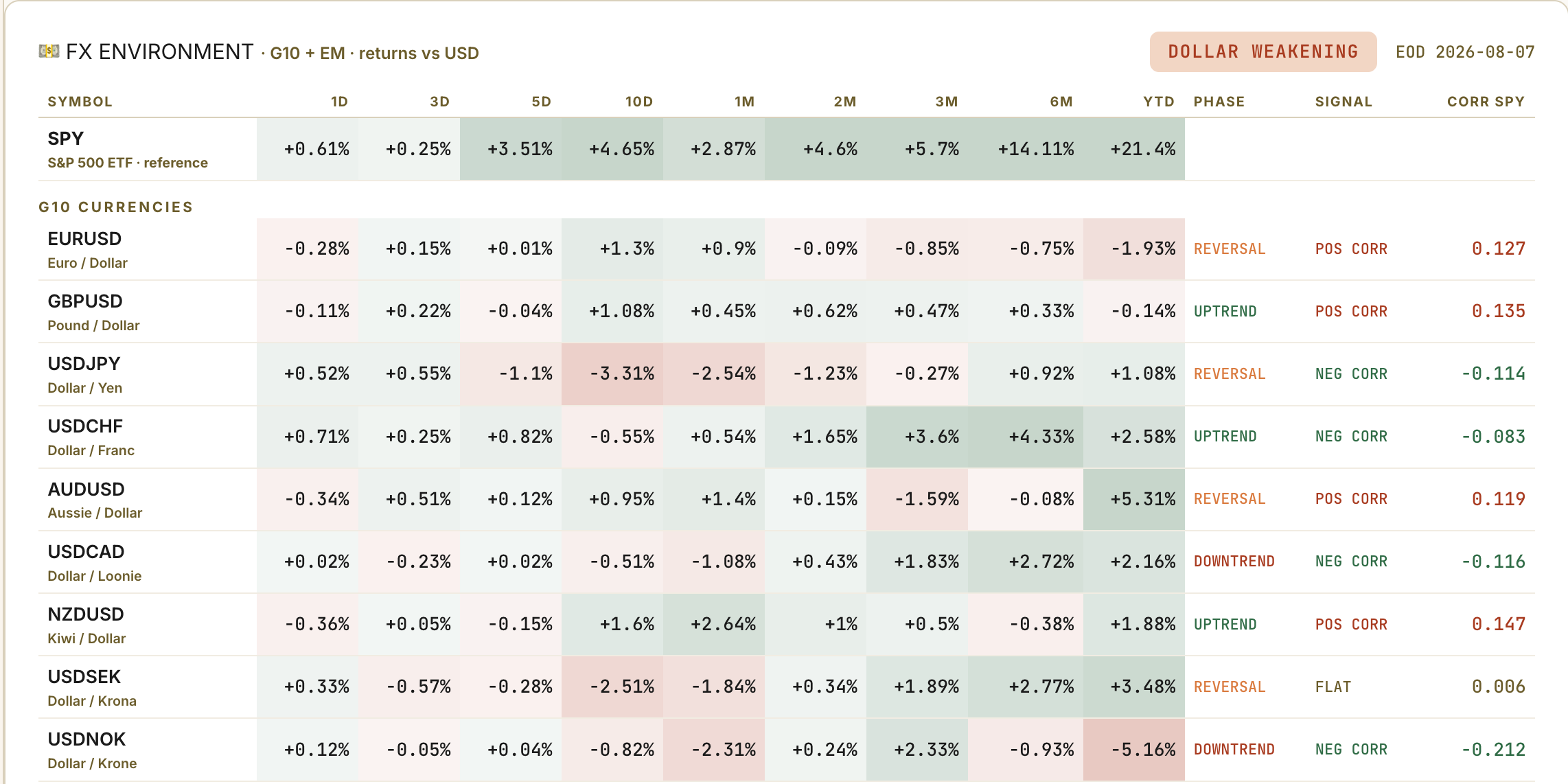
Two weeks ago Japan spent an estimated fifty-nine billion dollars defending the yen, with Washington joining in for its first yen purchase since 2011. I said then that the yen was dead to me as a signal until officials step away, and it stayed dead: a currency that gains 1% while the dollar falls is going nowhere under supervision. The franc, my other fear gauge, did even less.
So neither of the two things that move when investors are frightened moved at all, and the dollar itself barely fell, which rules out the currency explanation for the metals too. What is left is the real rate: price out hikes while inflation expectations sit still, and the return on cash after inflation falls. Gold competes with cash and nothing else.
The strange part deserves its own paragraph, because the mechanics matter.
Washington did not sell dollars to buy yen, which is the conventional playbook. It sold euros. Scott Bessent wants a strong yen and a strong dollar at the same time, so the Treasury reached into its euro reserves, handed the orders to Goldman and Morgan Stanley through the New York Fed, and Europe reportedly found out afterward.
Selling euros was the elegant version, and the elegance is the point. It let Washington strengthen the yen without ever saying that America wants a weaker dollar. But that trick only works while the intervention stays small, and the yen carry system is anything but small. Policymakers are defending an almost impossible corridor: a yen weak enough to keep the global carry trade alive, and strong enough to stop Japan importing an inflation crisis. Every successful defense invites a bigger test, and euro reserves are finite. The next serious round forces the choice this workaround was built to avoid: spending dollars, and saying so.
🧠 My Take
The calendar thins to one event. Nvidia reports August 26. Before that, CPI lands Wednesday at 8:30am, and it is the entire game.
Broadening continues, 45%
CPI comes in soft, the summation keeps climbing, the equal-weight index closes part of its gap, and financials convert the deepest participation on the board into price. The contradiction with my banks paragraph is only apparent: a bank earns the slope, and a front end falling faster than the long end widens its spread, which is why I watch the two-year against the ten-year. Base case because breadth this strong rarely reverses inside two weeks.
Concentration break, 30%
A hot CPI puts hikes back on the table and the three names carrying technology hand back the week. An index built on three companies has no cushion when they turn. Watch the equal-weight ratio for the first sign, because the damage arrives through the index itself and no sector inside it offers cover.
Real assets keep repricing, 25%
The metal is right and the bond market is late. The next Fed move becomes a cut, and the gold bid spreads into everything priced against a cheaper dollar. Capped at 25% because the miners already printed 20% in five sessions, and one payroll report does not make a policy path.
🔥 Trade of the Week:
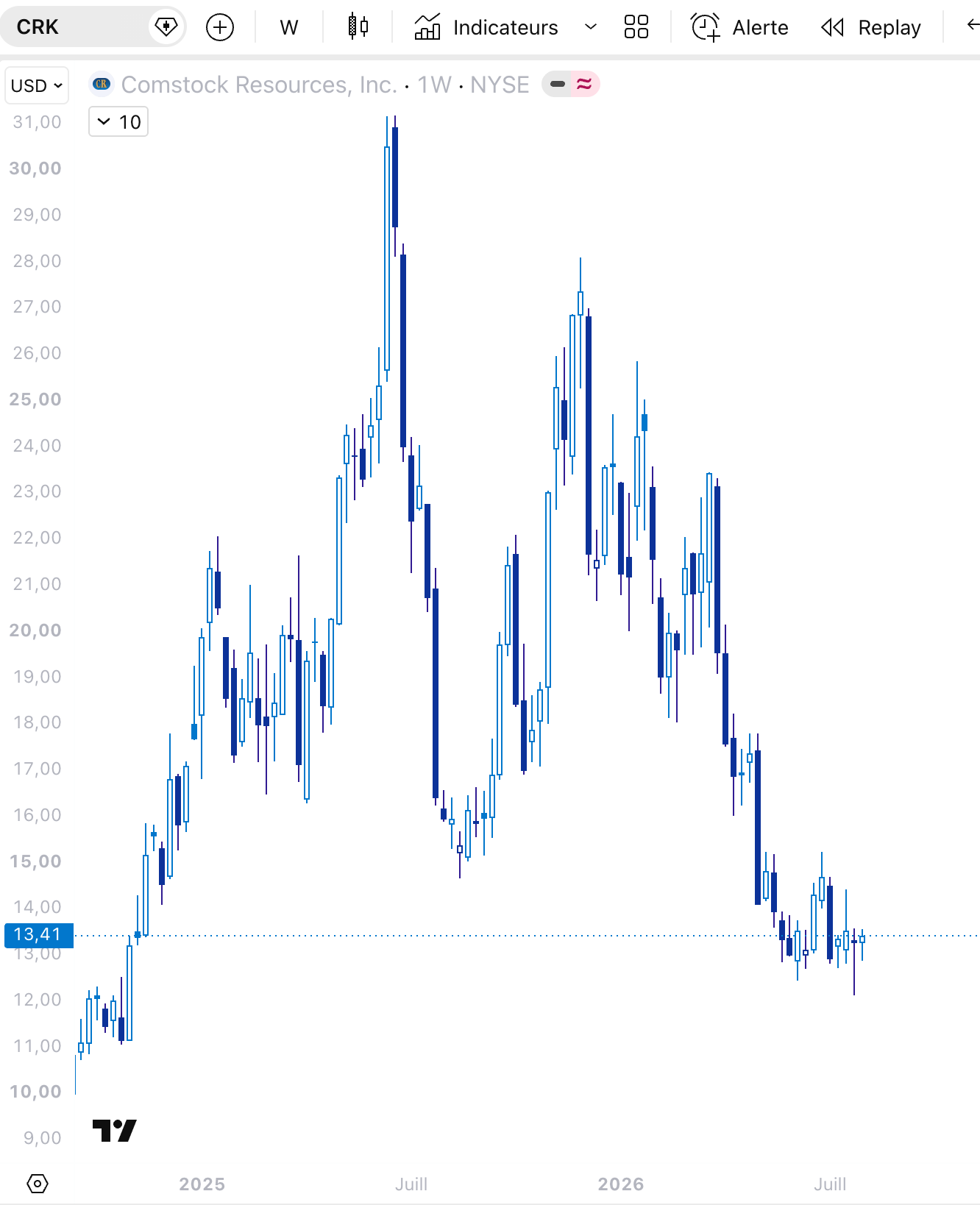
If the front end has peaked, every real asset gets repriced against a cheaper future dollar. Gold did it in five sessions. Natural gas has not moved, and Comstock Resources closed Friday at $13.41, up 1% in a week the index made 3.5%.
The July 29th print was ugly: revenue eighty million short and a 7.4% drop to a fresh 52-week low. Underneath, production rose 16%, six hundred million from the Pinnacle sale repaired the balance sheet, and second-half guidance was reaffirmed. The miss came from the price of gas, and a cheap commodity is a different problem from a shrinking business.
Then there is the hub: 5.2 gigawatts of gas-fired power with NextEra on the Western Haynesville, a billion cubic feet of gas a day by 2031, and Comstock doubling its wells on that field this year. Last week I bought the turbines. This is what the turbines burn, and it has not been bid.
The honest part
This is the riskiest idea I have run in months. The stock is 52% off its high, under both of its moving averages, in the week’s worst sector, and my screeners cannot see a warm winter or another year of cheap gas. A hot CPI kills the real asset case, and nothing cushions a name that has not moved yet. The payoff is slow on top of that, 2028 through 2031, so it earns a small ticket and nothing more.
Sizing: small. A fallen name, in the weakest sector of the week, with a catalyst three years out.
Entry: half around $13.40, half toward $12.70 on a retest into the July low.
Stop: a daily close below $12.10
Target 1: $15.
Target 2: $16.50.
Stretch: $18.70
See you next week,
Daniel
P.S. The app is the daily version of what you just read, the same boards and screeners I run every morning before I trade. It now comes with a free 7-day trial.

Disclaimer
This newsletter is for educational and informational purposes only. It is not financial advice.
The content reflects personal opinions shared publicly as a journal. Trading stocks, options, futures, or any financial instrument involves significant risk. You can lose your entire investment. There is no guarantee of profit.
The author is not a registered investment advisor, broker, or financial professional with any regulatory authority including the SEC or CFTC. Always consult a licensed financial advisor before making any investment decisions.
By reading this newsletter, you accept full responsibility for your own trading and investment choices. Past performance does not guarantee future results. Markets are unpredictable.
Screenshots are courtesy of TradingView, VixCentral, and other platforms with which the author has no affiliation. Information shared may contain errors or become outdated quickly.
This content is the intellectual property of the author. Copying or redistributing without permission is prohibited.
By continuing to read, you acknowledge and accept these terms.
Read the desk every week
Market analysis in plain English, plus the app that scans the whole US market for you.
Become a member Read the original on Substack ↗